This article first appeared in The Edge Malaysia Weekly on December 1, 2025 – December 7, 2025
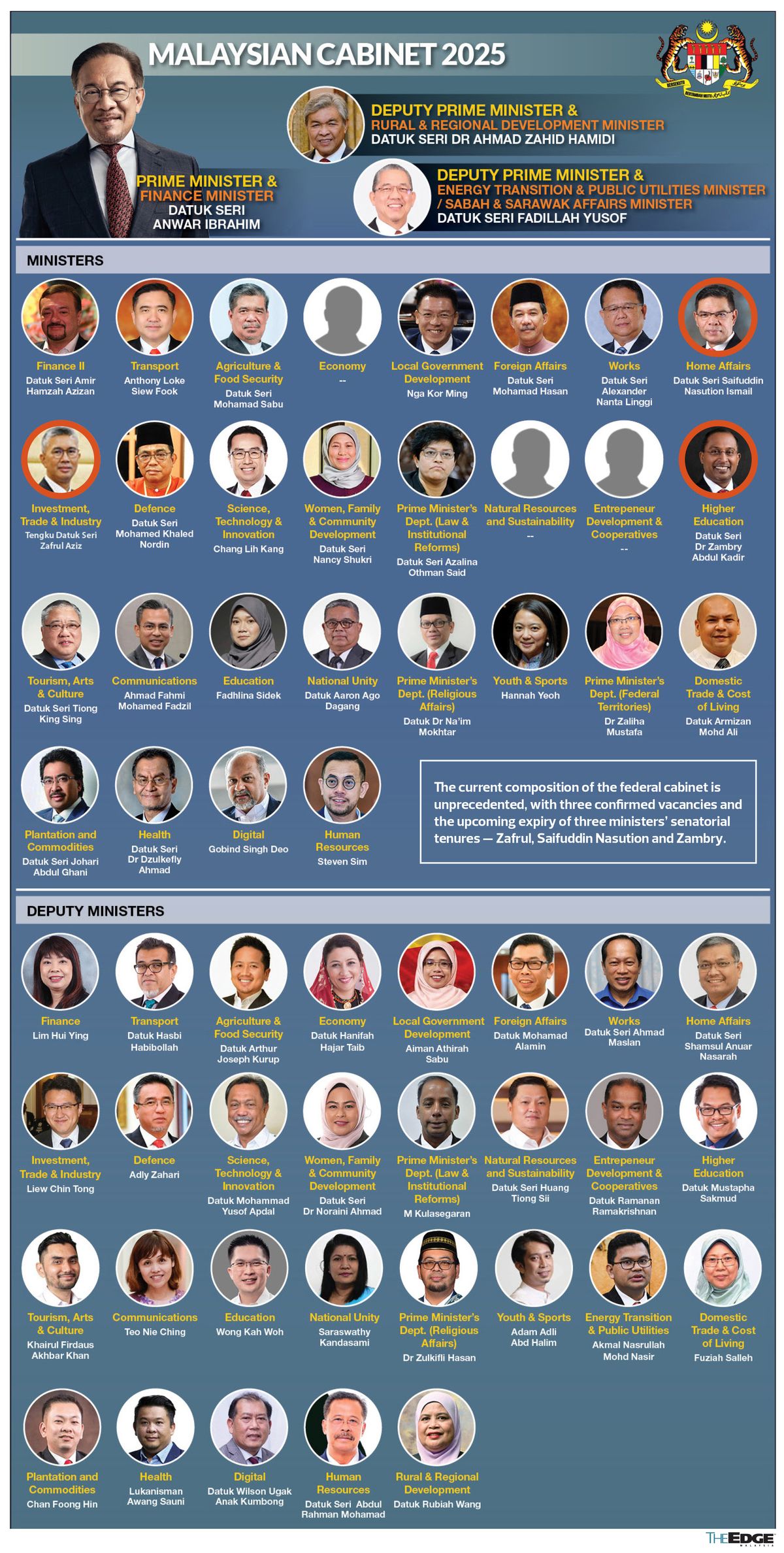
THE current composition of the federal cabinet is unprecedented, with three confirmed vacancies and the upcoming expiry of three ministers’ senatorial tenures.
The most recently vacated position was the minister of entrepreneur and cooperatives development earlier this month, when United Progressive Kinabalu Organisation (Upko) president Datuk Ewon Benedick resigned due to his disagreement with the federal government’s handling of Sabah’s claim to 40% of the net federal revenue derived from the state.
Before this, we had the double resignation of Datuk Seri Rafizi Ramli and Nik Nazmi Nik Ahmad as the minister of economy and minister of natural resources and environmental sustainability respectively, after they lost in the Parti Keadilan Rakyat (PKR) elections in May.
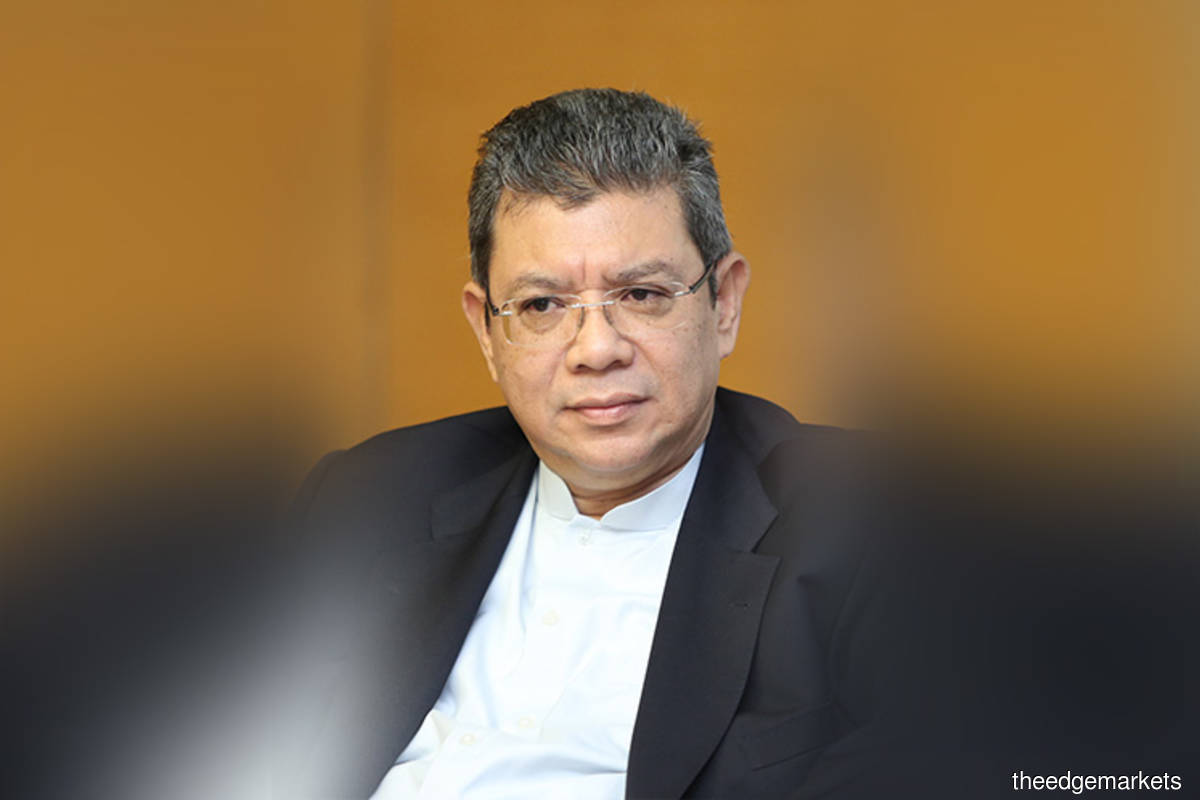
Then, Tengku Datuk Seri Zafrul Abdul Aziz must step down from his position as the minister of investment, trade and industry by Dec 2 when his maximum two-term tenure as a senator ends, having served since March 2020.
The senatorial terms for Datuk Seri Saifuddin Nasution Ismail, minister of home affairs, and Datuk Seri Zambry Abdul Kadir, minister of higher education, are also set to expire soon. Both were appointed to Dewan Negara in December 2022.
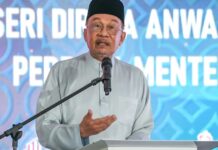
This places the spotlight squarely on Prime Minister Datuk Seri Anwar Ibrahim. Will he conduct a full cabinet reshuffle or merely fill the vacancies? Tongues are already wagging over who the candidates may be.
Whoever he chooses, the PM will have to weigh several key considerations, especially competency, political stability and public perception.
“The reshuffle must reflect both performance and coalition balance, ensuring the Madani government remains functional and credible ahead of several state polls,” says Sivamurugan Pandian, a professor at the School of Social Sciences at Universiti Sains Malaysia (USM).
Prior to Upko pulling out from Pakatan Harapan (PH), the coalition had 81 seats in the Madani government. This is followed by Barisan Nasional (BN) with 30 seats, Gabungan Parti Sarawak (GPS) with 23 seats and Gabungan Rakyat Sabah (GRS) with six seats.
This resulted in 16 cabinet posts for PH — including one for Upko — followed by seven for BN, five for GPS and one for GRS.
There are also two non-politician professionals in the cabinet: Datuk Seri Amir Hamzah Azizan as minister of finance II and Datuk Mohd Na’im Mokhtar as minister in the Prime Minister’s Department (religious affairs).
After Zafrul left Umno in May to join PKR, PH gained a minister, bringing its cabinet count to 17, while BN’s dropped to six. This led to Umno demanding that the Ministry of Investment, Trade and Industry (Miti) portfolio be returned to the party. All BN ministers currently come from Umno.
Anwar will be keen to maintain the government’s balance and show that his PH coalition remains in the driver’s seat, especially after the resignations of Rafizi and Nik Nazmi in July.
This is particularly relevant as the country enters an election cycle, starting with the Sabah state election on Nov 29. The terms of the Melaka, Sarawak and Johor assemblies are also ending next year, while parliament could be dissolved anytime from now, should Anwar seek an earlier mandate to solidify his leadership.
“When you do a cabinet reshuffle, especially with the general election coming up, you have to keep an eye on it (the upcoming state elections),” says James Chin, professor of Asian studies at the University of Tasmania.
“But the more important thing is that the cabinet reshuffle is always about strengthening your programmes, delivering to the people, so you have something to show at the next general election.”
Performance versus perception
It does not have to be said that politics is about popularity. However, government policies might not always be popular with the people, especially those involving tough reforms.
This means that as Malaysia enters its election cycle over the next two years, Anwar will need to balance cabinet performance with public perception.
“As the country moves closer to elections, perception can outweigh performance … Anwar’s reshuffle must signal responsiveness to public sentiment while maintaining fairness to his team. It’s ultimately about projecting renewal and credibility for the Madani government,” says USM’s Sivamurugan.
While it is unclear if ministries other than the six affected positions will be reshuffled, some ministries have come under more public scrutiny than others.
Anwar tends to defend competent, reform-driven ministers unless the issues become too politically costly, says Sivamurugan.
Two ministries that have been under constant pressure to perform are the Ministry of Education (MoE), led by PKR Wanita chief Fadhlina Sidek, and Ministry of Health (MoH), helmed by Parti Amanah Negara vice-president Datuk Seri Dr Dzulkefly Ahmad.
Both MoE and MoH are the government’s largest ministries in terms of budget. MoE received an allocation of RM64.1 billion for 2025 and will be getting RM66.2 billion under Budget 2026 — the highest among the ministries. MoH received an allocation of RM45.3 billion for 2025 and is set to get RM46.5 billion for 2026.
Incidentally, MoE was the ministry that Rafizi originally wanted, calling it the most important portfolio for reforming the country.
The Sabah election factor
The outcome of the Sabah election may significantly influence cabinet movements, as almost all major contestants in the state polls, with the exception of Perikatan Nasional (PN), are part of the Madani government.
“The representation for Sabah in the federal cabinet will have to reflect the aspiration of the Sabah electorate. Madani’s strength in parliament would not be affected even if one or two parties pull out [from the government],” says Wong Chin Huat, a political scientist attached with Sunway University.
This means that whoever wins the Sabah election will try to assert their influence on the Madani government.
The major coalitions in the Sabah election are GRS led by caretaker chief minister Datuk Seri Hajiji Noor, BN Sabah led by Datuk Seri Bung Moktar Radin, and Parti Warisan led by Datuk Seri Mohd Shafie Apdal. Both GRS and BN Sabah are part of the Madani unity government at the federal level.
Prior to Ewon’s resignation, Sabah had only two ministers in the 31-member cabinet. The other was Datuk Armizan Mohd Ali, minister of domestic trade and cost of living, who represents Papar under GRS.
Anwar may use the reshuffle to strengthen federal-state relations and signal inclusivity towards Sabah leaders, particularly in the light of the shifting political landscape. “Borneo has become PM’s focal point to gain continuous support,” says Sivamurugan.
The issue of Sabah’s constitutional rights to 40% of the net revenue that the federal government derives from the state has already caused political realignment, notably leading to Upko quitting the PH coalition.
The issue has become a rallying call for many of Sabah’s political parties as the campaigning for the state’s election gets underway.
Its impact has been felt by the Madani government, which chose not to appeal the Kota Kinabalu High Court ruling in the suit brought by the Sabah Law Society against the federal government.
“I think the Sabah state election results will have some impact on Anwar’s decision [on cabinet reshuffling]. If PH manages to gain more seats, especially [through] his own party, PKR, it will create a positive momentum. But if the outcome remains status quo or declines, it will have negative implications for PH as the ruling coalition,” says Hisommudin Bakar, executive director of ILHAM Centre, a public opinion research outfit.
PKR is fielding 10 candidates in the Sabah election, while its PH coalition partners Democratic Action Party (DAP) and Amanah are contesting eight and four seats respectively, bringing the total PH seats to 22. There are 73 seats being contested in the election.
PKR held two seats in the preceding Sabah state assembly — Inanam, within the Sepanggar parliamentary constituency, and Api-Api, within Kota Kinabalu.
While Sabah’s parliamentary seats only make up 25 or 11.3% of the 222 seats in the Dewan Rakyat, it is still a sizeable block. When no single coalition had secured a clear majority in the 2022 general election, the support of these Sabahan MPs — along with those from Sarawak — was essential for maintaining federal stability and confidence in the prime minister. At present, the majority of Sabahan parliamentarians support the Madani government at the federal level.
At this juncture, it is too early to speculate whether Sabah will get more representation in the federal cabinet after the state election, as cabinet representation is conventionally based on the number of seats a party holds in the Dewan Rakyat, not in the state assembly.
If the winning Sabah coalition demands greater federal representation, the balance within the unity government could be affected.
Is the balance of power shifting within Madani?
The resignations of Rafizi, Nik Nazmi and Ewon have reduced PH’s cabinet posts to 14. Amir Hamzah — the minister of finance II — is currently the acting minister of economy, while BN’s Datuk Seri Abdul Ghani is the acting minister of natural resources and environmental sustainability.
Most political analysts expect the composition of the cabinet to remain the same, as there will be no change to the composition of the government’s seats in the Dewan Rakyat. However, the change in the power dynamics of PH and BN within the Madani unity government cannot be understated.
The loss of Rafizi and Nik Nazmi has reduced the talent and leadership pool within PH — especially that of its anchor party PKR. Meanwhile, Umno is said to be courting Khairy Jamaluddin, its former youth chief and minister, back into its fold, after sacking him from the party in 2023.
Could BN ask for more portfolios in a reshuffled Madani cabinet? For USM’s Sivamurugan, this is a possible scenario, given the coalition’s nature and need to maintain political balance among its components.
“Anwar will likely be cautious in ensuring that PKR retains a strong presence, especially since it anchors the Madani government.
“A full swap or reallocation to Umno could invite perceptions that PKR’s influence is decreasing, so a more probable outcome is a limited adjustment — one that rewards loyalty and performance without undermining PH’s leadership position,” he says.
However, Wong of Sunway University, does not think so.
“The baseline is [this]: Umno is unlikely to get more ministerial portfolios than what it currently has (including Zafrul’s). For example, if takes economy, Umno would have to give up another post like Miti,” he opines.
He adds that the new ministers to fill the portfolios of economy, and natural resources and environmental sustainability will most likely be from PKR, unless there is a swap of posts with other parties.
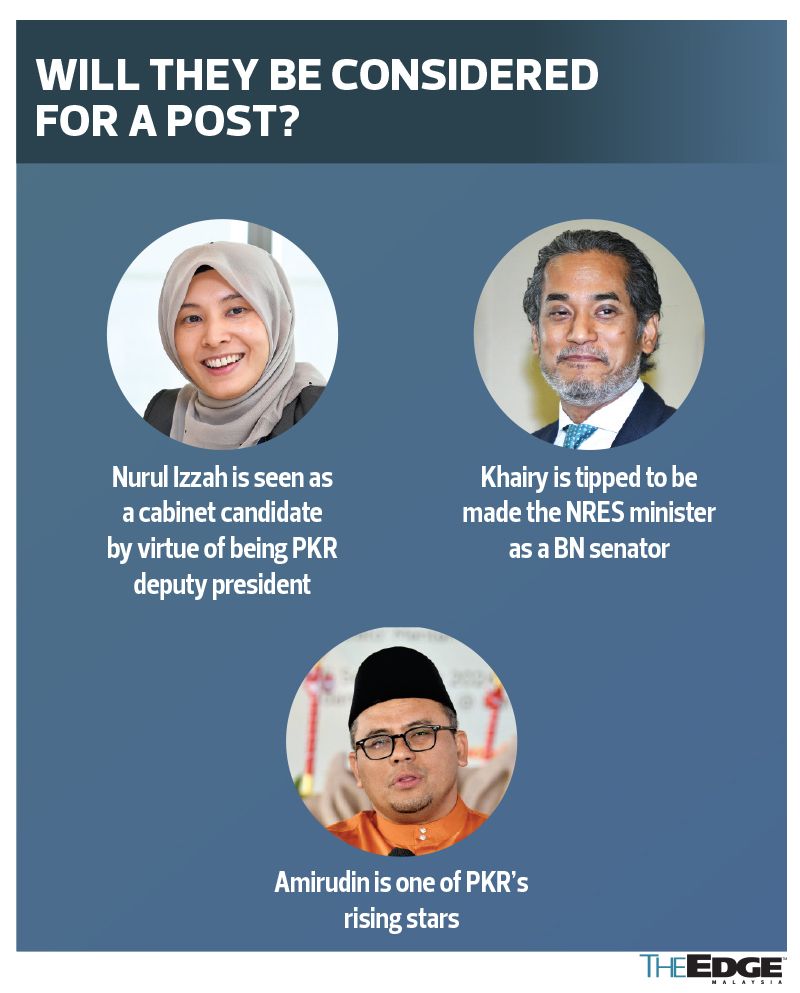
“One potential contender for economy is Nurul Izzah [Anwar], but it might be easier for her to take over education (also a key position that PKR would not want to give to other parties), where it is easier [for her] to outperform the predecessor,” says Wong.
Nurul Izzah won the deputy president post in PKR’s recent party election, beating Rafizi. If she were made a minister, she would have to be sworn in as a senator, and have only about two years to complete her term.
Strengthening the economic team
For Chin of University of Tasmania, addressing economic issues, especially those involving cost of living, will be the key consideration for Anwar as he relooks at his team.
“I think most people in Malaysia are very worried about cost of living issues and the economy. So, he (Anwar) has had two years to fix the economy and most people think that he has not done so.
“If he doesn’t fix the economy with elections coming up in two years’ time or less, he’s going to have a major problem,” says Chin.
While macroeconomic numbers such as the growth of gross domestic product, foreign direct investments, Consumer Price Index and the ringgit signal an improving economy, many still feel that the cost of living issue has yet to be tackled.
The economic portfolio has been overseen by Amir Hamzah since Rafizi’s resignation. If the government is adamant in having an economy ministry, then the position will have to be filled up.
“Divided attention is not for ministerial leadership, unless the purpose is to train ministers and enhance their experiences in different portfolios (as in Singapore, where junior ministers are often given a second task),” says Wong of Sunway University.
However, it should be noted that the Ministry of Economy under the Madani government is not as powerful as the economic affairs ministry was under the PN government, when Datuk Seri Mohamed Azmin Ali was helming it.
The Madani government’s economy ministry oversees the Department of Statistics and the Economic Planning Unit. Under the PN administration, the ministry also oversaw bumiputera empowerment and land and rural development matters.
Who might go where?
Nurul Izzah is seen as a candidate for a cabinet position due to her being the deputy president of PKR. Conventionally, the top leadership of a governing political party will be made ministers.
Johari, the minister of plantation and commodities, has also been said to be BN’s candidate for the Ministry of Economy portfolio. However, as Wong points out, this would mean BN releasing the Miti portfolio to PKR.
Some quarters have raised the question of whether Johari, a former finance minister II, may negotiate for a higher post.
Meanwhile, there is also talk of a professional being made a senator and appointed to the economy ministry.
Although Zafrul cannot be appointed to the Dewan Negara anymore, Wong of Sunway University opines that he will likely be appointed as a ministerial envoy to work hand in hand with the Miti minister.
“Such a position would help Zafrul to keep his relevance and public visibility, helping him in GE16 (16th general election), but this won’t reduce PKR’s existing quota in ministerial portfolio,” says Wong.
As for Zambry and Saifuddin Nasution, whose first term as senators will end this December, it is likely that they will be appointed for a second term and be retained as the ministers of higher education and home affairs respectively.
Meanwhile, the Ministry of Natural Resources and Environmental Sustainability (NRES) which, among others, oversees the Department of Environment, Forestry Department of Peninsular Malaysia as well as the Department of Director General of Lands and Mines, will be influential as the government develops policies for the mining of rare earth elements.
Khairy, who was expelled from Umno in January 2023, is tipped to be made the NRES minister as a BN senator. He was sacked after criticising and calling for the resignation of Datuk Seri Ahmad Zahid Hamidi as party president.
Meanwhile, the Ministry of Entrepreneur and Cooperatives Development portfolio could again go to a junior partner of the Madani government, most likely a winner in the Sabah election. Since Upko is no longer part of PH, the portfolio could go to GRS, if the coalition wins big in the state’s election.
Another notable candidate for a cabinet position is Datuk Seri Amirudin Shari, the menteri besar of Selangor.
Amirudin received the highest number of votes among PKR’s four vice-presidents in the recent party election, making him one of the party’s rising stars. In contrast, Chang Lih Kang, the current minister of science, technology and innovation, received the least votes among the four VPs.
As Malaysia sails into choppy political waters with the start of the election cycle, Anwar faces a significant challenge in balancing the
ship, where every cabinet appointment must satisfy coalition partners while projecting competence and responsiveness to the people.
Save by subscribing to us for
your print and/or
digital copy.
P/S: The Edge is also available on
Apple’s App Store and
Android’s Google Play.