
This article first appeared in Capital, The Edge Malaysia Weekly on August 24, 2026 – August 30, 2026
LOOKING at the benchmark FBM KLCI, the Malaysian stock market may seem relatively quiet, but beneath the surface, investors have been piling into smaller-cap counters, particularly those tied to semiconductors, data centres and power infrastructure, sending some stocks doubling in just a matter of months.
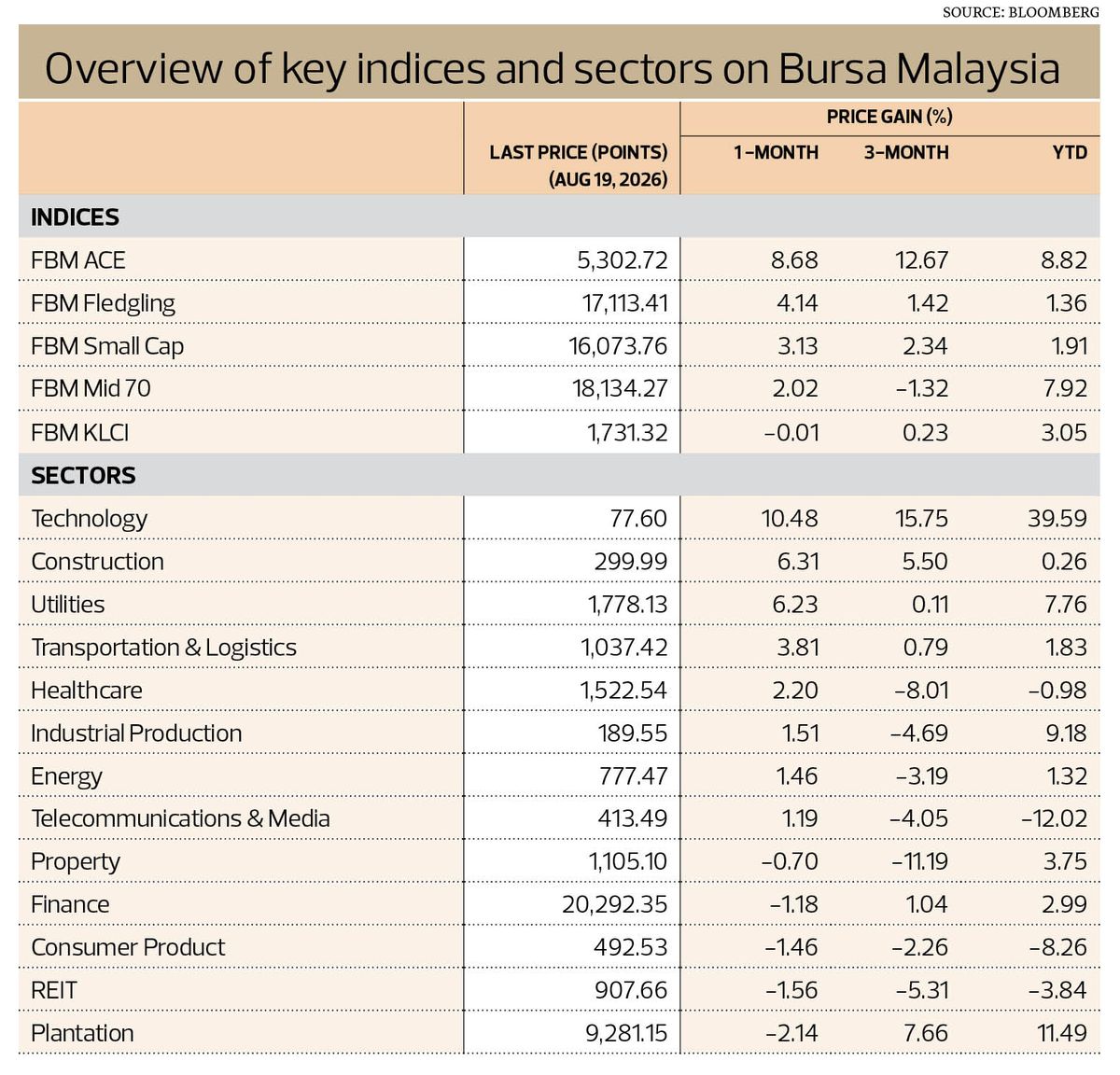
The FBM ACE Index, which tracks companies on Bursa Malaysia’s secondary market, has roared back to life. It has climbed 8.7% over the past month, making it the best-performing index during the period with levels last seen around October last year. The index is also trading well above its 200-day moving average, underscoring the strength of the recent rally.
The next strongest performer is the FBM Fledgling Index, which captures the bottom 2% of Main Market stocks by market capitalisation and typically comprises smaller and less actively traded companies. It has gained 4.1% over the past month and appears to be forming a cup-and-handle pattern, adding to signs that investors are moving further down the market-cap spectrum in search of higher-risk, higher-return opportunities.
The broader small-cap market has also outpaced the blue chips. The FBM Small Cap Index has risen 3.1% over the past month, compared with a 2% gain in the FBM Mid 70, while the FBM KLCI has been broadly flat.
The divergence shows where the real action has been in Malaysian equities. Investors have been rotating into higher-beta counters and stocks exposed to the country’s structural investment themes.
Technology has led the sectoral gains, rising 10.5% over the past month, followed by construction at 6.3% and utilities at 6.2%.
The common thread running through many of the biggest gainers is Malaysia’s positioning in the global artificial intelligence (AI) and data centre investment cycle. Semiconductor companies are benefiting from stronger orders, while data centre development is driving demand for construction, power and water infrastructure, as well as mechanical and electrical (M&E) contractors.
Plantations have also joined the broader rotation. Although the sector fell 2.1% over the past month on profit-taking, it remains up 7.7% over three months, supported by expectations of a strong El Niño that could tighten palm oil supply and underpin crude palm oil prices.
The price action among individual counters has been even more striking.
Semiconductor cleanroom automation player Stratus Global Holdings Bhd (KL:STRATUS) surged 163% on its Bursa Malaysia Main Market debut on July 21, from its 80 sen IPO price to close at RM2.11. The stock subsequently hit near-limit-up territory on Aug 7 and has since climbed to RM2.87, nearly 3.6 times its IPO price.
Semiconductor equipment and materials supplier Mi Technovation Bhd (KL:MI) and NationGate Holdings Bhd (KL:NATGATE), which assembles high-performance servers and optical networking and photonics products, have also seen their share prices gain about 70% to 80% over the past two months.Meanwhile, smaller-cap names such as automated manufacturing solutions provider ECA Integrated Solution Bhd (KL:ECA) and automated test equipment supplier VisDynamics Holdings Bhd (KL:VIS) have roughly doubled.
The power infrastructure trade has been similarly strong. Kee Ming Group Bhd (KL:KEEMING), Critical Holdings Bhd (KL:CHB), HE Group Bhd (KL:HEGROUP) and Jati Tinggi Group Bhd (KL:JTGROUP) have at least doubled over the past three months as investors priced in continued contract opportunities from grid upgrades and data centre projects.
In plantations, WTK Holdings Bhd (KL:WTK), Sarawak Oil Palms Bhd (KL:SOP) and Sarawak Plantation Bhd (KL:SWKPLNT) have been among the stronger performers, each gaining at least 20% in less than two months.
The question is whether the surge marks the beginning of a broader rerating of Malaysian equities, or whether investors are increasingly chasing a narrow group of high-beta stocks whose valuations have moved ahead of their earnings.
Fund managers broadly agree that the underlying investment themes are genuine. Where they differ is on how much of the recent rally is already reflected in the share prices.
Affin Pheim Asset Management fund manager Khoo Zing Sheng sees a strong fundamental foundation, particularly in technology. He points to the aggressive AI infrastructure spending by US technology giants Meta Platforms Inc, Microsoft Corp, Alphabet Inc and Amazon.com Inc, which is cascading through the semiconductor supply chain and creating greater demand visibility for Malaysian outsourced semiconductor assembly and test players, equipment suppliers and component manufacturers.
“Most Malaysian technology stocks are now guiding full order books through 2026-2027, with strong earnings expected in the next one year,” he says.
Khoo believes the rally is being supported by both earnings growth and a rerating of semiconductor stocks as investors reassess their longer-term growth prospects.
Tradeview Capital chief investment officer Nixon Wong is similarly constructive, pointing to stronger macroeconomic fundamentals, improving earnings expectations and renewed foreign interest.
Malaysia’s second-quarter economic growth of around 6%, accelerating exports and visible investment momentum in data centres, semiconductors and construction have strengthened the case for local equities, he says.
But KAF Investments fund manager Neoh Jia En offers a more cautious assessment. He argues that the market’s recovery has been driven primarily by improved risk appetite rather than earnings growth, noting that corporate earnings estimates for 2026 and 2027 have remained broadly flat over the period.
More than half of Malaysian stocks are still posting negative returns, he says, while the rally among smaller companies has been concentrated in just two industries — technology and M&E contractors.
“Unfortunately, we have yet to see evidence of a bull market, given the narrow market breadth,” says Neoh.
Opportunity or speculation?
The sharp gains among smaller companies have inevitably raised questions about whether the market is becoming speculative.
Wong says the gains were due to a mixture of fundamentals and valuation expansion. Some companies have genuine earnings catalysts, but in cases where share prices have risen much faster than earnings estimates, expectations are becoming increasingly demanding.
He believes institutional investors are participating in the small- and mid-cap rally, albeit selectively. Quality small- and mid-caps are attracting institutional interest, while the more speculative end of the market is likely still dominated by retail investors and short-term trading.
For investors who have already missed the first leg of the rally, Wong says the easy money has probably been made in some of the recent winners.
The focus should now shift to companies where earnings estimates are still being revised upwards, valuations remain reasonable and there are identifiable catalysts.
Khoo sees genuine opportunities among smaller companies benefiting from the AI infrastructure boom.
Most institutional investors have minimum market-cap requirements that exclude the true small caps, he says. But some companies valued at a few hundred million ringgit, particularly, are starting to attract institutional attention.
As larger companies operate at full capacity, orders are spilling over to smaller players, creating what Khoo describes as potential “hidden gems” in the supply chain.
Neoh, however, believes investors should be more discerning. He says the recent small-cap recovery is better described as a sector-specific rally rather than a broad-based resurgence.
That distinction is particularly apparent in semiconductors.
Share prices moving faster than earnings
Some of the smaller semiconductor-related companies with little or no earnings have delivered some of the biggest gains — a divergence that has become one of the clearest signs of speculative activity in the current market.
Neoh says part of the outperformance can initially be explained by valuation catch-up. Investors positioned themselves in larger semiconductor names where earnings inflections were expected to emerge earlier, before moving down the market-cap spectrum in search of the next beneficiaries.
But he believes the move has gone beyond a simple catch-up trade in some cases.
There is now evidence of investors buying companies simply because they have been briefly mentioned by another semiconductor player, or because they expect the company to reach break-even, while paying little attention to whether the share price already exceeds its discounted future cash flows.
Wong also acknowledges that speculation has entered the sector. The underlying semiconductor cycle is improving, particularly around AI, advanced packaging and data centre demand. But when share prices run substantially ahead of fundamentals, expectations become harder to meet. “Disappointment would trigger a more serious selldown on these names too.”
Khoo, who is more positive on the smaller players, argues that some are benefiting from genuine demand spillover as larger companies reach capacity.
The distinction, therefore, is between companies with concrete orders and those simply riding the semiconductor narrative.
The concern becomes more apparent when valuations are taken into account.
Neoh estimates that most larger-cap semiconductor names are trading at around 35 to 40 times 2027 earnings, implying that high growth expectations are already embedded in share prices. “Share prices have moved ahead of earnings.”
He notes that the Bloomberg consensus 2026 earnings estimate for the Bursa Malaysia Technology Index remains below its level at the beginning of the year despite the sector’s strong share-price performance.
Investors, in effect, are paying today for earnings growth further down the road.
That does not mean the semiconductor cycle is over. Neoh expects companies with stronger pricing power to see earnings inflect earlier and believes these are the names that are more likely to outperform expectations over the longer term.
Wong is also cautiously optimistic, saying the sector may now be entering an earnings upgrade phase. Some companies, however, are still incurring upfront costs to prepare for future customer demand, meaning earnings may initially lag the share-price performance.
For investors, that makes stock selection increasingly important.
Powering the next leg
If semiconductors represent the market’s technology growth story, power infrastructure represents the physical investment needed to support it.
M&E contractors have been among the biggest beneficiaries after securing data centre-related contracts, followed by orders linked to semiconductor plants.
Neoh expects the theme to receive further support from potential power infrastructure awards by Tenaga Nasional Bhd (KL:TENAGA) over the next one or two months, with another wave of data centre-related awards possible by year-end.
Wong believes the investment cycle has several years to run.
Tenaga Nasional’s Regulatory Period 4 provides RM42.8 billion of capital expenditure from 2025 to 2027, he notes, while the infrastructure opportunity extends beyond data centre construction to grid upgrades, substations, cabling and other systems needed to support higher electricity demand.
“AI is structurally positive over the longer term,” says Wong.
Khoo points out that some infrastructure and construction stocks previously traded at 10 to 15 times earnings when the power infrastructure opportunity was less recognised. The market is now willing to assign them valuations of 15 to 20 times.
At current prices, he believes investors have largely priced in one to two years of visible earnings growth, but not necessarily the full three- to five-year investment cycle.
Neoh is more measured, saying TNB-related contracts should be viewed primarily as a recurring earnings base for M&E contractors rather than a growth engine. The winners, he says, will be contractors with sufficient capacity, strong execution capabilities and the ability to move up the value chain.
Plantations offer value rotation
Plantations provide a different proposition from the market’s technology and infrastructure growth stories.
Wong says elevated CPO prices, supported by biodiesel demand and potential El Niño supply risks, should continue to underpin healthy cash flows for upstream planters.
The sector has also become a natural rotation target after the strong run in growth stocks, with investors turning to plantations for asset value and cash generation.
Neoh, meanwhile, thinks the probability of El Niño has largely been priced in, with plantation stocks having run ahead of CPO prices. Still, he sees room for stronger dividend payouts from planters with healthy cash flows, particularly as some potential payouts have yet to be reflected in analyst estimates. This could provide a positive surprise for the sector.
Earnings test
For all the optimism surrounding Malaysia’s structural growth themes, the rally is now entering a more demanding phase. The biggest immediate question is whether earnings can catch up with share prices.
Wong describes the market as entering a validation period as investors wait for corporate results to justify increasingly demanding expectations. This could lead to some consolidation in the near term.
Neoh sees the bigger risk coming from global markets. Rising global bond yields could trigger a valuation de-rating, particularly among stocks whose valuations have become stretched. A more hawkish US Federal Reserve, renewed geopolitical tensions or an energy-price shock could weaken risk appetite and trigger foreign outflows.
Khoo highlights a more specific risk: the AI spending cycle itself. If higher interest rates or inflation force the hyperscalers to become more disciplined with capital expenditure — or if their huge AI investments fail to generate sufficient returns — they could slow spending on data centres and computing infrastructure.
That would have repercussions throughout Malaysia’s semiconductor, data centre and power infrastructure plays.
The next phase of the market rally could therefore look very different from the past three months’.
The structural themes remain intact. Malaysia’s data centre buildout is supporting demand for power infrastructure, while the global AI investment cycle continues to underpin the semiconductor supply chain.
But simply owning the right theme may no longer be enough.
Investors will need to identify companies with the order books, capacity and execution capabilities to translate those themes into earnings.
Wong favours a barbell approach, combining quality large caps such as banks and utilities with selected second liners, particularly semiconductor companies with strong guidance and track records and construction players exposed to data centre and power infrastructure.
Khoo remains positive on semiconductors and data centre-related opportunities but stresses the importance of concrete contracts and rising earnings forecasts.
Neoh, meanwhile, sees opportunities outside the market’s hottest trades, particularly in oil and gas. Some mid-cap oil and gas stocks are now offering high-single-digit dividend yields because their share prices have fallen amid concerns over a long-term decline in energy demand. He believes the market may be too pessimistic, with stronger energy prices potentially prompting higher industry capital spending and an earnings recovery in 2027.
The three views point to a market that is healthier than a purely speculative rally, but not yet broad enough to be called a full-fledged bull market.
The themes are real. The question now is whether the earnings are real enough to justify the prices.
Save by subscribing to us for
your print and/or
digital copy.
P/S: The Edge is also available on
Apple’s App Store and
Android’s Google Play.



.JPG "Report: Perlis, Kelantan and Terengganu could move into Phase Two by next week, says source | Malaysia")